Thursday, September 27, 2012

Being a Kid on a Ship in Africa

While there are many things we give up by choosing to live here (on a ship, yet tied to a dock; in Africa, but not really IN Africa; in a HERE that changes every few months, while the members of our "household" change daily), there are many OTHER things that we gain.

I remember as we were preparing to come to Mercy Ships and explaining to people that we were going to work in Africa with an organization that provides free surgeries.  The general concept was warmly received.  "Wow.  That is so cool."  Then the practical gears of their minds would kick in and ask questions like, "what about your house? What about your job?  How much will you get paid?"  And our favorite, "What about your kids? What are you going to do with them?" 

Surprisingly, we planned on bringing them WITH us.  Crazy as it sounds, we think sticking on the same continent as a family is the best kind of plan.  

And it seems that the girls would concur.  They enjoy the unique moments that make up the ordinary moments here.   

Here are a few examples of moments that stand out:

They have a chance not just to learn about the world, but to live, laugh, and love with 30-40 other nationalities.  Not only hearing about differences, but experiencing them. As we move from country to country the academy study that place, pray for that place, and get to learn about that place first hand.


here we are arriving into the port of Conakry.

And below you'll see an atypical Sunday evening - making 2000 peanut butter and jelly sandwiches for screening day volunteers and patients, the night before our big screening day.


Forts, forts and more forts! Our walls and beds are steel so magnets and anything cloth make for a fort building utopia -  no matter the time of day or how many are available to play.

A new Snuggie fort??
Here are the girls as I'm trying to tuck them into bed!  How do you get the squirrelies out??

 They share a room that is about 12 feet long and 7 feet wide.  You'd think that we'd have very little in the room to dirty it, but Savannah is a little bit like that Peanuts character...what was his name?  Ah, yes.  Pigpen! 

After a few days of delaying, stalling and excuse making, she ran out of chances to "clean it later."  The bedtime book was shut and she was sent to bed while I confiscated all the items on the floor - of which only one or two were Kylie's.  Wow! Without the yards and the parks and the activities around town, they still manage to have a lot of fun, and like using their imagination once again.

Can you spot the Pillow Pet?

Not to say that we don't have any new toys. We have our share of electronics (maybe more than our share!), and they have turned into computer whiz kids. 

The girls also have dedicated teachers that pour all their energy into their classes - whether there are two students or ten!  (yes, the biggest class onboard has ten 4th and 5th graders combined).  The academy received three new smartboards this year and the teachers, parents and kids have enjoyed using these new educational toys as well! 

On back to school night, the kids educated the parents with activities, games and a glimpse into their think-out-of-the-box approach to school in a small white, floating ship where space might be limited, but the learning is endless. 


During work experience week, all the 6th-12th graders are able to choose a department and shadow for the week.  Last year we had people working in the cafe, as writers, as nursing and dental assistants, in hospital supply management, with the deck department and at reception.


We've traveled to Sierra Leone, Ghana, Togo, and the Canary Islands.  We're learning and practicing French in context of developing friendships here.  We are seeing people's physical lives changed and watching the (sometimes painful) process of how the body heals, and how that opens the door to a complete life transformation.
So, while they miss things like Chick-Fil-A, snow and bowling, the girls are receiving lifelong lessons and a perspective like no other.

Savannah, during a Fire Drill on the dock, after an Egyptian lesson done in collaboration with the British School of Lome, Togo.

Friday, September 14, 2012

Hospital Sterilizing Room: After School Activity

  
The girls have been blessed to have made some amazing friends on the ship, and with those friends come perks.  (I mean, isn’t that one of the best benefits of friendships?). 
One particular friendship with perks is with our friend Jane.  We met Jane in January 2011 as she did Gateway training with us (joining us in everything from silly ice breaker games (top photo) to Basic Safety Training (2nd photo)).  She comes from Canada.  She has been working in the OR Sterilizing Room since we came onboard.  Jane and her team get all the instruments and gnarly equipment after a gory surgery and boil, steam, and sterilize so they are appropriately cleaned and ready for future use.  If you’ve ever watched a surgery, you’ll know how messy it can be.  Let’s face it:  surgery is bloody.  So this room is ultra-important to the health and well-being of our patients.

Jane with her team of guys: Juan from Dominican Republic, and Frank, Mark and George from Sierra Leone

The day of the Main Screening Day, Jane had been asked to stay onboard and get the equipment ready for surgeries that were due to open soon.  We also asked her to be “on-call” for our children. She gladly accepted this responsibility, and then later wondered if they might want to accompany her down to the sterilizing room for a new activity.  Certainly they would! 

Surgeries had not yet begun but some of the packages had been opened and needed to be re-sterilized, and some of the instruments needed to be re-sterlized after the sail.  The girls wouldn’t get to see the room at its worst, but still they could have a bit of the adventure.

So, Savannah and Kylie and their friend Jessica suited up in scrubs, or caps, shoe covers and readied themselves for entering this sterile environment. 

They spent their time putting litmus paper into sterlizing packs (as an indicator of expiration dates), putting eye tools into their sterile packs and sealing them, and (of course) listening to music.


 What a treat to have a great friend, the opportunity to see something new, and this amazing community around us!
Jane was a trooper putting up with our little rugrats all afternoon and evening.  By the time we finished at the screening site and returned to the ship it was nearly 9:00pm. 

She said about a million girls came over to the cabin for dinner too.  I think she must have exaggerated since there are only about 25 little girls on the ship, but I believe that there were 8-10 of them eating in our cabin!

Kylie had a long day - helping out with the other junior and senior highers at screening with water and food distribution, playing with the children, and serving as an escort among the stations.  She enjoyed being a part of the big screening day, but equally enjoyed feeling important in this special after-school job!  Thanks Jane!


  ­­ 

Wednesday, September 5, 2012

Screening Day: What Hope Looks Like

5:30am.  The alarm goes off and jostles me awake in the pitch blackness.  Rain drizzles outside.  Breakfast started at 5:00am today.  I stumble to the dining room for a bowl of porridge (um, oatmeal, I mean).  Already we have had crew posted through the night around the Palais du Peuple, the People's Palace.  Yesterday we showed up at 2:00pm to set up the stations, walk through the building, and prepare for the big day.  As commonly happens in Africa, things didn't go quite as expected. 

We weren't able to utilize the whole building yet.  A wedding and concert were scheduled Sunday night at the venue, after we were promised it in entirety from 2:00pm on.  The man with the keys for the room where our tables and chairs are being stored doesn't show up.  So we return, late in the evening, with headlamps and torches (sorry, flashlights) to move chairs, tables and hang maps.    Lord, what are you doing?  Will the patients come?  Did word get out adequately?  Will the rains keep people away?  Will safety prevail?  How will we look back on this day?

Prayers are going up worldwide.  By the thousands.  By the tens of thousands.  The network of people lifting up this event to the Lord looks like an AT&T worldwide coverage ad.

We caravan in the dark through the city.  Land Rover after Land Rover.  If they didn't know we were here yet, they do now.

The line - it's like a congo line.  People running, hobbling, shuffing but just can't catch up to its end.  From 200 standing in line at 4:59am to 2000 in a matter of minutes.  They are showing up by the carload.


Are they just curious?  Have they heard that miracle workers are here?  Will they be looking for asthma, arthritis and cures for genetic defects?  For some, yes. 

But, oh!  The large numbers of facial tumors!  They keep coming!

This is what hope looks like. 
The fear -  of seeing these faces that have been stretched beyond recognition by forces beyond their control - this fear, is gone.  Now my face lights up with joy as I see these precious ones who have lived in desperation for years, ashamed and devastated by their own appearance.  And they come, afraid to set their hopes too high, convinced that they are beyond help. 

I make eye contact, finding the eye that has the best visibility - this can be the trickiest part.  I smile from the depth of my heart.  A smile that says, "You are welcome here! You are not forgotten!  God has not given up on you.  He sees!  We are SO glad to see you!"

First by a trickle and soon a swiftly flowing river of patients make their way through the maze of stations we have.

4300 people have come through the iron gates onto the front lawn of the People's Palace.  Nurses evaluate each and every person who has chosen to wait hours in first the drizzle, then the clouded humidity, and finally the sun.  Over 500 people are screened by our eye team outside and determined that we could potentially help them further. 

Those with other surgical issues we could potentially treat are escorted inside to begin the collection process on their information.  Each type of condition is brought to see doctors, surgeons and nurses to determine the next step: schedule a surgery, xray, CT scan, waitlist or if we are unable to help.   Escorts continue to guide the nearly 850 patients (plus their loved ones) through the three stories of stations.


Finally they reach the ground floor (Ground Zero) and they are nearing the end of their day with us.  I await at the Card Issuing Station.  And we see them all: Orthopedic patients: little ones with feet seemingly attached upside down, babies with Kermit the Frog legs whose knees look like they are reversed as they touch their chests effortlessly, twelve-year olds that measure three feet tall with legs bowed almost in a complete circle.  Babies, children and teens with cleft lips and palates - their beautiful smiles of joy stretching even wider than our lips allow.  Patients who had surgery on one of the previous Mercy Ships, the Anastasis, in 1998 to repair a condition and now have returned for their follow up surgeries.  They have waited 14 years for our return!  Sierra Leonean patients have crossed the border with their paperwork that states they will need a second surgery and even though that date is November or next January, they come expectantly, knowing the schedule is limited.  VVF ladies have found there way here, with a big "YES!" written on their paperwork from our nurses.  The crook of a burnt arm, the taut marbled skin of a burned cheek and eyelid, both young and old have suffered at the hands of an open flame. The embarrassed faces, the shame that has veiled them vanishes as I stretch out my hand with a "Bon Soir, comment ca va?"  To be looked in the eye and treated as a valued equal, to know that there is a chance that help has arrived for them.  This gives them a tangible hope.

They leave with a plastic card: PATIENT.  They each have a name, a number, and the next step.  For some it's another screening day (on a smaller scale, with a specific surgeon who will identify his/her own patients), for others it's being on a waitlist and they are told to keep their cell phones turned on.  And for others they have an appointment on the ship - a Scan.  An Xray.  An admission.

These are the days when we see that for hope to be credible in the future means that we have to be tangible in the present (US Ambassador Robert Seiple).

This is a day when you can taste the hope. 

These are the days I live for.


Sidenote:  These are the only photos that have been made available to us so far from the screening day.  Please stay tuned- I will do another post with the best photos our communications department took when they are available. 

Friday, August 31, 2012

Sailing, Ships and New Sights: Guinea

My apologies in the delay... Technical difficulties complicated by hurricanes, bad satellite connections and shared Internet with 300 others are only a few of my lame reasons for a delayed entry the past couple of weeks.

August 15 we set sail from Tenerife where the ship had completed its many 5-year surveys (not questionnaires, but technical inspections).  Tenerife was a time when we were reminded that we live on a ship, not just a floating hospital.  The engineers, deck and special project departments worked (literally) around the clock to complete all the necessary work that needed to be done this summer.  For those of us not in those departments, it tends to be a slower season - one of preparation and planning for the next field service, or picking up the pieces from the last.


With the work complete, we prepared to sail.  How do you prepare to sail?  By securing everything to a surface so if the boat sways 20 degrees in either direction, nothing gets destroyed or destroys you.  All knick knacks off the shelf.  Anything standing needs to be secured to the walls or ceiling (bungee cords around the fridge to keep it closed, and a brace to attach it to the ceiling).  Televisions get moved to the floor.  Computer towers and monitors get caulked to the desks.  Small objects are sticky tacked into place.


Does the ship empty out in the summer?  No.  There were still over a hundred crew that were onboard  - in addition to the technical crew there were others to cook, run power, pay bills, tour the guests, clean, process visa and customs paperwork, prepare for the arrival of new crew, etc.... For some of our crew, especially those from West Africa, this was their first time traveling to a Western country - a huge culture shock!


Cabin secured? Check.  We are off.  We sail 24 hours a day now - and see a lot of the same thing:  sea, sea and sea. 

Sunrise.
All day, all evening.


I've been on a speedboat.  The Africa Mercy certainly does not qualify.  We aim for a speed of 10 knots, but some days we puttered along slower than that.  The seas were calm and the dolphins came out to play.


After five days we saw evidence of land:  many ships in the waters with us, and water birds.
The excitement of the arrival builds, even with the 49 academy students onboard!  They've been learning about Guinea in preparation!


Pulling into Conakry brings all sorts of anticipation - when will this feel like home?  Will it be like Togo? Will it be like Sierra Leone?  Will I love this country more than any other?  Will we make friends here? 
Conakry is on a small peninsula (an island, actually, that has been connected to mainland by a bridge) and was built with grandiose colonial style so beautiful carnival looking buildings await us.  As do the familiar sites in the port - large car transport ships, fishing vessels, hard-working men of various ages looking to find a day's wage in the unloading hustle, port officials in uniform with weapons, and the dusty, puddled cement docks that will become our driveway.

Guinea greets us with three beautiful islands just a couple of miles from shore.  Dan's mouth waters at the thought of the close fishing and diving possibilities here.  
The pilot boat comes alongside us and the port's "pilot" enters our ship to help escort us to our correct berthing space. 

The band strikes up.
Our Advance Team welcomes us with smiles and shouts of joy as their home pulls into sight after three months of living in Conakry and getting things set in place for this next year. 
The Guinean flag is brought to the dock in a diplomatic ceremony between the Ministry of Health and other government officials and our mercy Ships leadership. 


And it begins again.  My home has moved, but nothing has changed on the inside. It's a weird concept to wrap my brain around.  When I walk out the same hallway and down the same gangway, it's a new land that awaits.  My running route is unknown.  The language is new.  (Anyone out there speak Susu? Mandinka? Pular?)  Where can we find our favorite street snacks?  What are these streets called?  Do we know anyone that lives close by?  The answers to these are still unknown. 

We look forward in expectation to learning more about Guinea.  Here's what we know:
  • It's a land of over 10,000,000 people comprised of over 30 ethnic groups. 
  • 85-90% of the nation practice Islam, 5% follow Jesus and the other 5-10% hold traditional animistic beliefs.
  • Official language of Guinea is French, but most people speak their tribal language at home.
  • Independence was achieved from France in 1958 and there have been four (officially recognized) presidents since: 
    1. 1958-1984: Ahmed Sékou Touré ruled from 1958 until 1984 as a malevolent dictatorship - during his rule more than 1,000,000 fled to seek refuge in other nations and over 5,000 were believed to have been tortured & killed in Camp Boiro, a concentration camp modeled after those in the Soviet Union.
    2. 1984-2008: Lansana Conté ruled from 1984 until 2008
    3.  2008-2010: Moussa Dadis Camara seized control through a military junta and survived an assassination attempt.
    4. 2010: First "fair" elections held since independence and after five months of election, Alpha Condé was declared the winner.  The 2012 elections have been postponed indefinitely by the current president, saying they need to be ensure they are "transparent and democratic."
  • It's a beautiful land of mountains, waterfalls, rich in bauxite and diamonds and gold (and the mining companies know this). 
  • There are two seasons each year: rainy and hot.  We are arriving near the end of rainy season (29 days of rain in August on average with 44 inches of precipitation this month).  By November the rains should have stopped completely and the heat will be heavily upon us.
Stay tuned as we learn more about this beautiful place and these amazing people.

Friday, August 17, 2012

Preparing for Screening in Guinea


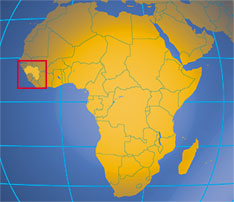
Our home is currently moving.  We are sailing across the North Atlantic - currently off the west coast of Western Sahara.  We will arrive in Conakry, Guinea sometime next week. 

We have already started running, but once we hit the ground, our running picks up the pace.  We are preparing for our main screening day.

Mercy Ships has not been to Guinea since 1999 so we will be working with a lot of new connections, new places, and new crew members.  Also, since we haven't been in the country for 13 years, we anticipate that there will be a huge amount of need - creating larger than normal crowds.

This year we won't be using a stadium for our screening, but rather the People's Palace (Palais du peuple).  This is a "large, Chinese-built auditorium that is home to two national ballet troupes."
 
This three-story building should be a great resource for us on screening day. We are arriving at the end of rainy season (an average of 44 inches over 27 days of rain in August, and dropping to 25 inches over 22 days of rain in September).  So, there is a good chance that rain will be falling outside.  Being able to bring the potential patients inside and having all the stations out of the rain (or intense sun) will be helpful.

Will you join us in praying over these next two weeks as we plan, prepare and train all those that will be involved? 

The entire crew plays a part in screening.  We need:
*drivers that will transport workers to and from the screening site,
*trained medical staff to take histories, do evaluations, draw lab work, and make the hard calls of who we will be able to assist,
*administrative folks (like myself) that will enter all the data onto each patient's card and our database,
*schedulers to methodically fill our OR calendars for the next ten months,
*pharmacists to give pre-op medications and vitamins,
*palliative care team to talk with patients who have incurable and untreatable conditions,
*prayer teams to comfort, console or rejoice with patients or family members,
*enthusiastic crew members to entertain the children waiting for hours in line,
*people willing to help with logistics to handle the water, snacks, lunch, toilet paper, trash bag, light bulbs and other necessities,
*our photographers to collect pre-op photos for each patient scheduled,
*public relations representatives to field any questions or make statements for the media or any government officials that show up,
*security guards to manage the crowd and keep everyone calm and orderly in the midst of desperation,
*and the list goes on.

But most importantly we need the patients. 

We anticipate long hours. Sore feet.  Blisters. Sweat.  Glitches in the best laid plans.  Long lines. 

But we also look forward with positive anticipation to bring a little bit of oxygen for that spark of hope that thousands have been carrying around with them.  A spark of hope that tells them, "one day, you might get medical help."  "Maybe there will be a way for you to receive treatment, despite the lack of resources." 

Thank you, Jesus, that you provide us that hope each day.  And thank you that we get to share that hope in a physical, tangible way to the thousands we will see.

Please pray with us that hope would be kindled at screening day. 


Tuesday, August 7, 2012

Top Questions: What You're Dying to Know!

We are back "HOME," that place that feels comfortable, welcoming, and familiar.  For us, in this season, that is the Africa Mercy.  It's not so much a physical location, since we are moving from country to country, but this strange, interesting, multi-faceted community that becomes a family despite our many differences.  Welcome hugs awaited us from our "family" from Ghana, Jamaica, Sierra Leone, Nepal, the UK, South Africa, Australia, Benin and Liberia, Canada, the US and Holland. 

We had an amazing time these past eight weeks on our first holiday back to American soil since joining the ship in February 2011.  While we were prepared for some culture shock, it was quite minimal and we adjusted back into the quick pace of life in the US fairly well.  Decision making was an even weaker point than it had been before, but that is probably just me!

While we shared our stories and our life we had several common questions come up, so I thought I'd address those here:

1.  How was Africa?
Simply, Africa is hot.  It is beautiful.  It is gross.  It is smelly.  It is amazing.  It is full of interconnected people who know what community looks like.  It is appalling at times at how primitive it can be, and shocking when you see glimpes of the modern.  75% of Africans have a cell phone, (while only 42% have access to electricity).  It is a hodgepodge of cultures, languages, people, traditional living and modern technology.  It is like you see in the photos, only magnified so much more in real life.


2.  Do you homeschool the girls?
 No!  Onboard the ship there is an accredited Christian academy (Mercy Ships Academy) that holds classes K-12.  All students receive instruction by an incredible crew of volunteer teachers in the subject areas of math, English, social studies, science, French, Bible, P.E., art, music and drama.  Class sizes range from 1-6 students.  This was one of the deciding factors for us on serving with Mercy Ships because our kids get to have such a rich, intercultural experience alongside us, and I am freed up to work during school hours and be a part of the bigger picture of Mercy Ships. 


3.  What do you miss the most about America?

This answer is different for each of us:  Seasons, snow, running through a park, being able to blend in a crowd and shop without hassle, cotton candy, fresh berries and seasonal fruits like peaches, Lucky Charms, backyard barbecues, boat rides, fishing in the river, a Sunday afternoon NFL game, get togethers with friends and family top our lists.

4.  What do you do on the ship?

The girls go to school, take ballet, piano, attend running club, Bible club, and spend most of their free time hanging out with friends or watching Disney (if they've done their chores).  Dan works as the Ancillary Services Supervisor in the Hospital- overseeing and directing the lab, pharmacy, bio-tech, radiology, palliative care and rehabilitation departments.  He will be transitioning over to the Patient Flow Manager in a couple of months which oversees the Screening Team and the traffic flow of patients in and out of the Hope Center, the hospital onboard the ship, and the entire process in between.  I am an Administrative Assistant helping out in Human Resources and the Hospital doing small, menial tasks so people with bigger responsibilities can take care of the big jobs.  I do a lot of work in Microsoft Excel updating or creating spreadsheets, managing statistics, chasing down signatures, paperwork and if I have extra time, I count pills for the pharmacy.   In our free time we interact with patients, play games, watch movies, workout, swim, or catch up with others over a cup of tea or coffee.


5. How much do you get paid to work on the ship?
We, along with almost all the other crew members on the ship, PAY to be here.  We are volunteers that have to raise our own funds to pay our crew fees (room and board), insurance, taxes, travel expenses, clothing, and all the other expenses you incur in life.  God has been incredibly faithful to go before us and raise the funds and we are so thankful.  There are several other crew members onboard that struggle, and if you are led to help, let us know and we'd be happy to connect you with someone that could use some help.  We have seen God's faithfulness time and time again as He meets our needs before we even ask. 


6.  Where do you live?
We live in basically a two-bedroom apartment onboard the ship.  We have our own bedroom, the girls share a room with bunkbeds.  It is about 440 square feet, but it feels plenty spacious.  It's amazing what you don't need when you live in a community. 


7.  Do you get seasick?
Well, probably if we were out at sea all the time, but as it is we have only sailed six days in the past 18 months.  We are tied to a dock for most of the year, in one country, and the only time we are let loose is when we are traveling to our next port.  For us that was a five day sail between Sierra Leone and Ghana, and then a one day sail to Togo.  If you are trying to work on the computer during that time, yes, you will probably get seasick, but after the first day or so we got used to the motion and learned how to walk down the hall with our hands extended to prevent bumping into the walls!


8.  Have you learned the language?
This is a little misleading.  The official language of each country we have been in has been either English or French.  We are working on learning French (creating a bit of confusion in my brain with all that Spanish mixed in there!).  However, these languages are the languages established and imposed by the colonial countries of England and France.  So, this tends to be the language stressed in school and business, but the home languages continue to be those that go back hundreds of years before European languages: twi, ewe, mina, soso, fong, mende, krio.  In any one country there may be 200 different languages spoken.  We have learned a few catch phrases of the major language of each port city we have been in, but no, we are not fluent!  Africans (and Europeans) continue to be shocked that Americans speak so few foreign languages, when they speak several fluently!

9. What's happening next for your family?  
This is what we have renamed the million dollar question.  We initially committed to two years with Mercy Ships.  This would end February 27, 2013.  However, we all feel that it would be difficult to transition away at that point in the school year and our outreach.  So, we will stay at least through the end of our field service in Guinea, which wraps up the end of May 2013.  We are not required to leave at that point though, so we are just praying to see if this will close out our season with Mercy Ships, or if the Lord would have us extend.  We won't get an eviction notice on our door - ideally they would love to see long-term crew stay as long as they feel God is leading them to do so.  Please join us in praying for direction in these big decisions. 


Fifth grade graduates having dinner out with their dads at the end of the school year in Togo